Journal Manuscript for Review
A double-spaced journal submission with continuous line numbers for reviewers, a running head, APA citations from a source list and a generated reference list.
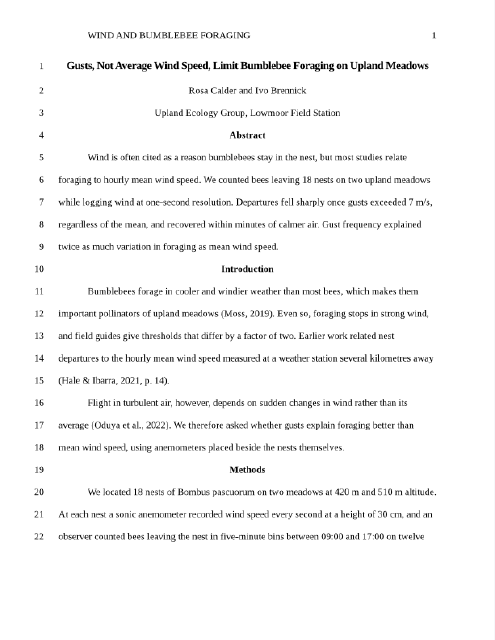
Set up the way journals ask for review copies: double spacing, line numbers running through the whole manuscript so reviewers can point at "line 23", and a running head with the page number on the right. The in-text citations are CITATION fields built from sources added to the document's source list in APA style, and the reference list at the end is the BIBLIOGRAPHY they generate, with hanging indents.
Steps
52 commandssteps:
- { command: review.proofing, as: proofing }
- { command: design.themeFonts, params: { heading: Tinos, body: Tinos } }
- { command: layout.lineNumbers, params: { value: continuous }, as: lines }
- { command: references.citationStyle, params: { style: APA }, as: style }
- { command: styles.modify, params: { style: Normal, chr: { size: 12 }, para: { align: left, spaceBefore: 0, spaceAfter: 0, indentFirst: 36, lineSpacing: { rule: multiple, value: 2.0 } } } }
- { command: styles.modify, params: { style: Title, chr: { size: 14, bold: true, color: { Rgb: [0, 0, 0] } }, para: { align: center, indentFirst: 0, spaceAfter: 0, lineSpacing: { rule: multiple, value: 2.0 } } } }
- { command: styles.modify, params: { style: Heading 1, chr: { size: 12, bold: true, color: { Rgb: [0, 0, 0] } }, para: { align: center, indentFirst: 0, spaceBefore: 0, spaceAfter: 0, lineSpacing: { rule: multiple, value: 2.0 } } } }
- { command: styles.create, params: { name: Centered Line, basedOn: Normal } }
- { command: styles.modify, params: { style: Centered Line, para: { align: center, indentFirst: 0 } } }
- { command: insert.header, params: { text: "WIND AND BUMBLEBEE FORAGING" }, as: header }
- { command: format.size, params: { size: 10 } }
- { command: para.tabs, params: { tabs: [ { pos: 468, align: right } ] } }
- { command: caret.docEnd }
- { command: text.tab }
- { command: insert.field, params: { instr: "PAGE", result: "1" } }
- { command: insert.closeHeader }
- { command: para.style, params: { style: Title } }
- { command: text.insert, params: { text: "Gusts, Not Average Wind Speed, Limit Bumblebee Foraging on Upland Meadows" } }
- { command: text.newParagraph }
- { command: para.style, params: { style: Centered Line } }
- { command: text.insert, params: { text: "Rosa Calder and Ivo Brennick" } }
- { command: text.newParagraph }
- { command: text.insert, params: { text: "Upland Ecology Group, Lowmoor Field Station" } }
- { command: text.newParagraph }
- { command: para.heading1 }
- { command: text.insert, params: { text: "Abstract" } }
- { command: text.newParagraph }
- { command: para.normal }
- { command: text.insert, params: { text: "Wind is often cited as a reason bumblebees stay in the nest, but most studies relate foraging to hourly mean wind speed. We counted bees leaving 18 nests on two upland meadows while logging wind at one-second resolution. Departures fell sharply once gusts exceeded 7 m/s, regardless of the mean, and recovered within minutes of calmer air. Gust frequency explained twice as much variation in foraging as mean wind speed." } }
- { command: text.newParagraph }
- { command: para.heading1 }
- { command: text.insert, params: { text: "Introduction" } }
- { command: text.newParagraph }
- { command: para.normal }
- { command: text.insert, params: { text: "Bumblebees forage in cooler and windier weather than most bees, which makes them important pollinators of upland meadows " } }
- { command: references.citation, params: { source: { tag: Moss19, kind: Book, author: "Moss, Adair", title: "Meadows in motion: Pollinators of the high pastures", publisher: "Fieldfare Press", city: "Lowmoor", year: "2019" } }, as: first }
- { command: text.insert, params: { text: ". Even so, foraging stops in strong wind, and field guides give thresholds that differ by a factor of two. Earlier work related nest departures to the hourly mean wind speed measured at a weather station several kilometres away " } }
- { command: references.citation, params: { source: { tag: Hale21, kind: JournalArticle, author: "Hale, Rosa; Ibarra, Tomas", title: "Wind speed and bumblebee foraging in coastal grassland", journal: "Journal of Pollination Ecology", year: "2021", volume: "29" }, pages: "14" } }
- { command: text.insert, params: { text: "." } }
- { command: text.newParagraph }
- { command: text.insert, params: { text: "Flight in turbulent air, however, depends on sudden changes in wind rather than its average " } }
- { command: references.citation, params: { source: { tag: Oduya22, kind: JournalArticle, author: "Oduya, Kemi; Lind, Sofia; Prescott, Hal", title: "Flight stability of bumblebees in gusty air", journal: "Insect Flight Mechanics", year: "2022", volume: "11" } } }
- { command: text.insert, params: { text: ". We therefore asked whether gusts explain foraging better than mean wind speed, using anemometers placed beside the nests themselves." } }
- { command: text.newParagraph }
- { command: para.heading1 }
- { command: text.insert, params: { text: "Methods" } }
- { command: text.newParagraph }
- { command: para.normal }
- { command: text.insert, params: { text: "We located 18 nests of Bombus pascuorum on two meadows at 420 m and 510 m altitude. At each nest a sonic anemometer recorded wind speed every second at a height of 30 cm, and an observer counted bees leaving the nest in five-minute bins between 09:00 and 17:00 on twelve days in July. A gust was defined as a two-second wind speed more than 3 m/s above the preceding ten-minute mean." } }
- { command: text.newParagraph }
- { command: references.bibliography, params: { title: References }, as: bibliography }
- { command: references.sources, as: sources }Checks
7 checks on every buildinspect.pages= {"count":2}results.lines.lineNumbers= {"restart":"continuous","countBy":1}results.style.style= "APA"results.first.tag= "Moss19"results.sources= {"count":3}- Diagnostics: none, the kit's own check finds nothing wrong
- The saved document opens again, and its thumbnail matches
thumb.pngwithin the render tolerance
Related
More Doc samples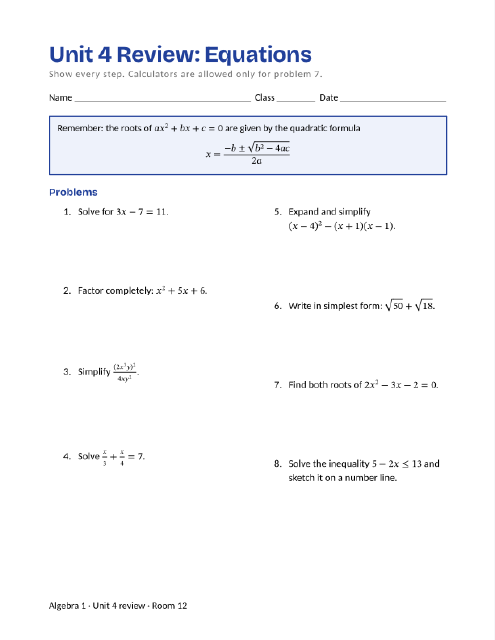
Algebra Practice Worksheet
A printable algebra worksheet — name and date lines, a shaded formula box with the quadratic formula, and eight numbered problems in two columns with inline equations and room to work.
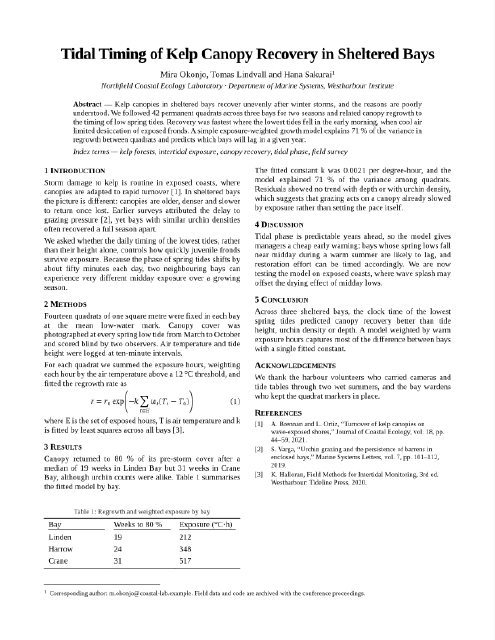
Two-Column Research Paper
A conference paper with a full-width abstract over a two-column body, a numbered equation, a ruled results table, a footnote and a bracketed reference list.
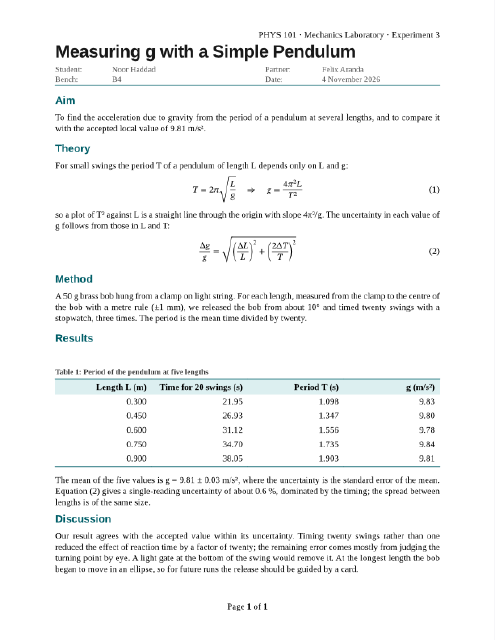
Physics Lab Report
A first-year physics lab report on measuring g with a pendulum — header block, numbered display equations, a captioned data table with a shaded header row and a "Page x of y" footer.
Phonics Poem Card
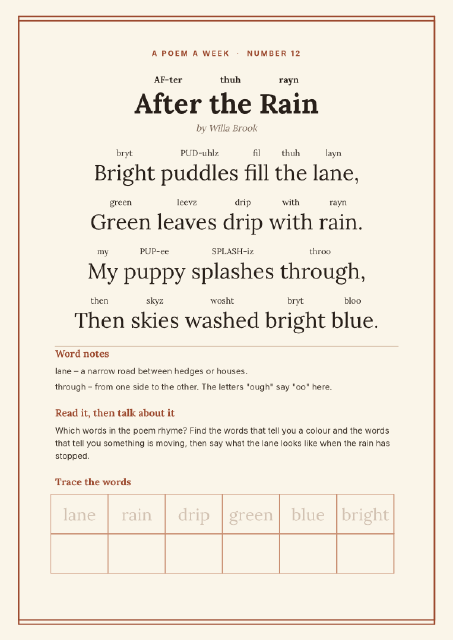
An early-reader poem card with a sound-it-out guide set above every word by Phonetic Guide (EQ) fields, on a tinted page inside a double border.